One company, over 650 years of history.
Our Origins
The Worshipful Company of Founders traces its origins to medieval London, where skilled craftspeople specialised in casting objects from molten metal. Known as founders, these artisans worked primarily with brass, brass alloys and tinplate ("laton"), producing everyday items such as candlesticks, pots, pans and other cast metalware.
Like many of the City's ancient guilds, the Founders came together to protect their craft, support fellow members, maintain standards, assist those in need and encourage learning and skills development. Their workshops were concentrated around Lothbury, a street in the City of London that remains at the heart of the Company's story today.
The earliest surviving evidence of the Company is a petition made in 1365 to the Lord Mayor and Aldermen requesting permission for its Ordinances to be enrolled at Guildhall. The petition was granted, and although the Company almost certainly existed before then, 1365 is recognised as the Founders' foundation year and formed the basis of the Company's 600th anniversary celebrations in 1965.
Remarkably, the Company's records stretch back over five centuries. The Wardens' Accounts survive from 1497, with only three other City Livery Companies possessing earlier records.
From Religious Brotherhood to Trade Guild
The Founders' origins appear to lie within a medieval parish fraternity known as the Brotherhood of St Clement, based at the church of St Lawrence Jewry. Like many such fraternities, it provided both spiritual and practical support to its members.
As London grew and trade became increasingly important, the organisation evolved. The social and religious aspects of the fraternity gradually gave way to a more formal role representing and regulating the craft itself. By the late Middle Ages, the Founders had become an established trade guild dedicated to safeguarding standards and protecting the interests of practitioners.
The Company was closely associated with St Margaret Lothbury from 1508 until 1987, when it moved to its present Hall at Cloth Fair. Today, the Founders maintain close ties with St Bartholomew the Great, one of London's oldest churches, where the Company's annual Election Day Service is held.
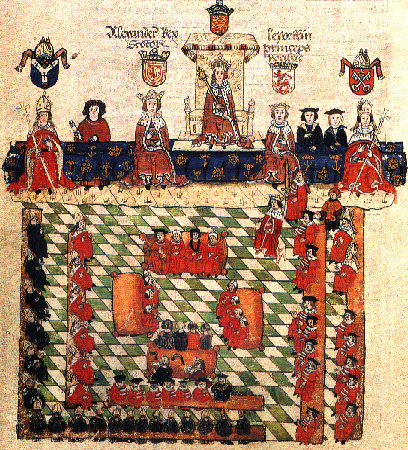
14th Century Parliament (from Wikimedia Commons)
London's Ancient Livery Companies
In the fourteenth century, London's trade guilds came to be known as "mysteries", a term thought to derive from the Italian word mestieri, meaning crafts or trades.
In 1364, Parliament decreed:
"All artificers and peoples of mysteries shall each choose his own mystery before the next Candlemas, and that having so chosen it, he shall henceforth use no other."
The Act helped formalise London's trade structure and cemented the role of organisations such as the Founders.
The distinctive liveries worn by members on ceremonial occasions would later give rise to the term "Livery Company", a title still used today.
Masters of Metal Casting
For centuries, the Founders stood at the heart of Britain's casting industry.
Their members produced bells, weights, monuments, machinery and countless other cast-metal objects that supported trade, industry and daily life. The Company's authority extended beyond representation of the craft. It was responsible for maintaining standards and protecting the public from fraudulent or defective products.
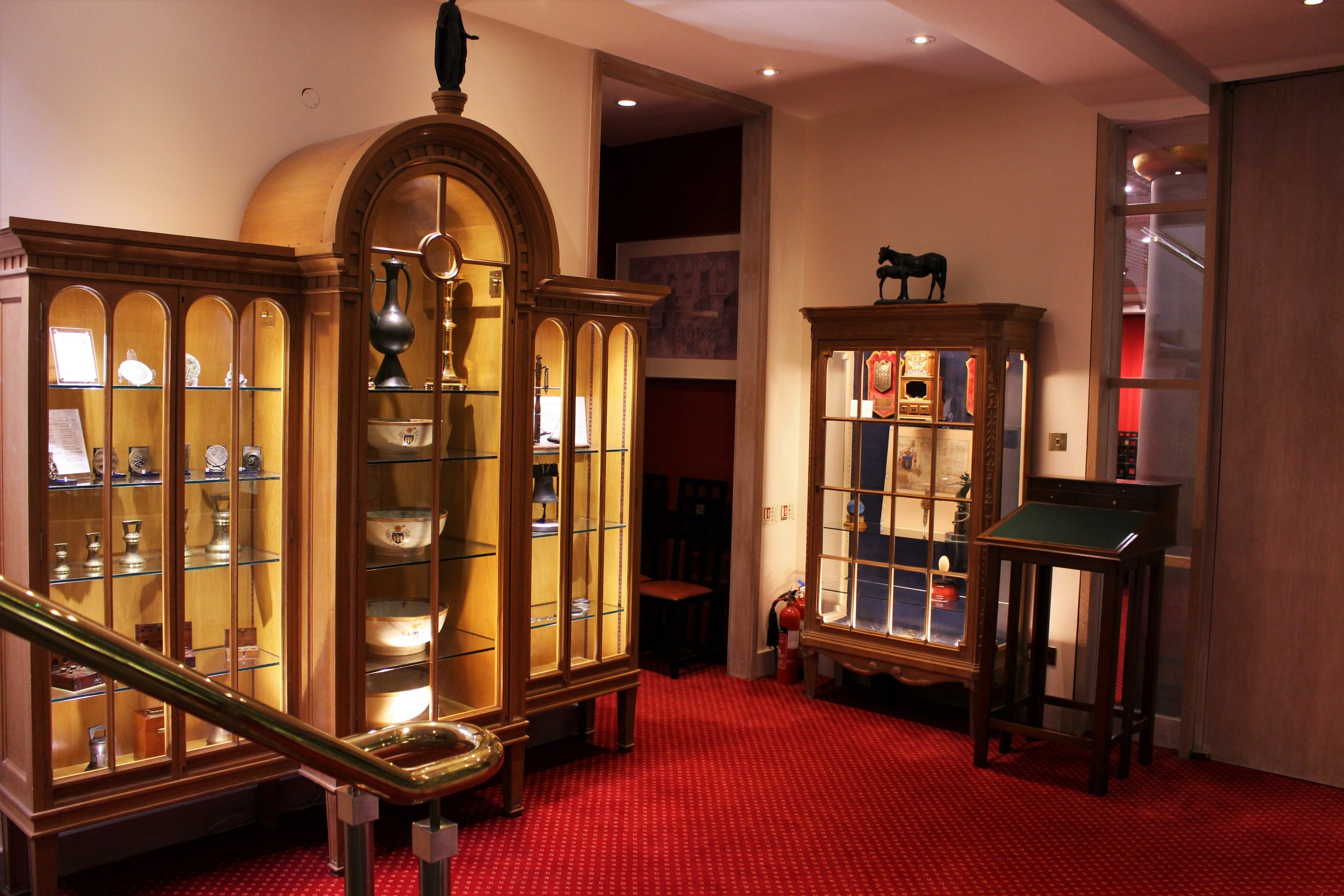
In the late sixteenth century, the Company secured the right to test and certify brass weights throughout the City of London. All such weights were required to be inspected and approved at Founders' Hall, helping to ensure fairness and consistency in commerce.
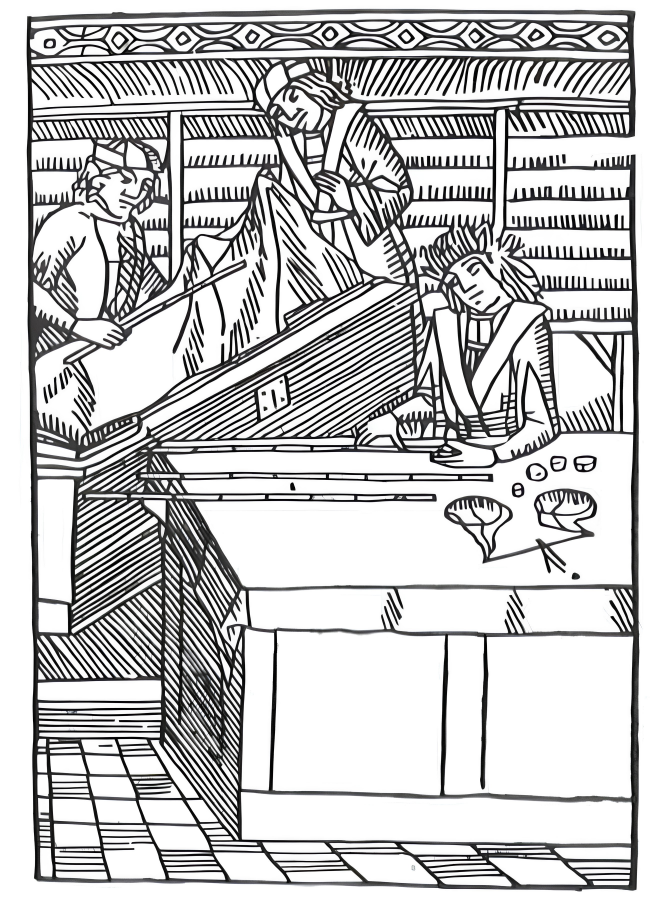
The craft itself could be noisy. Writing about Lothbury in the sixteenth century, the historian John Stow observed that founders spent their days turning and finishing castings by foot-powered methods which produced what he described as a "loathsome noise" to passers-by. Whether or not local residents agreed, the Founders' workshops played an important role in London's growing economy.
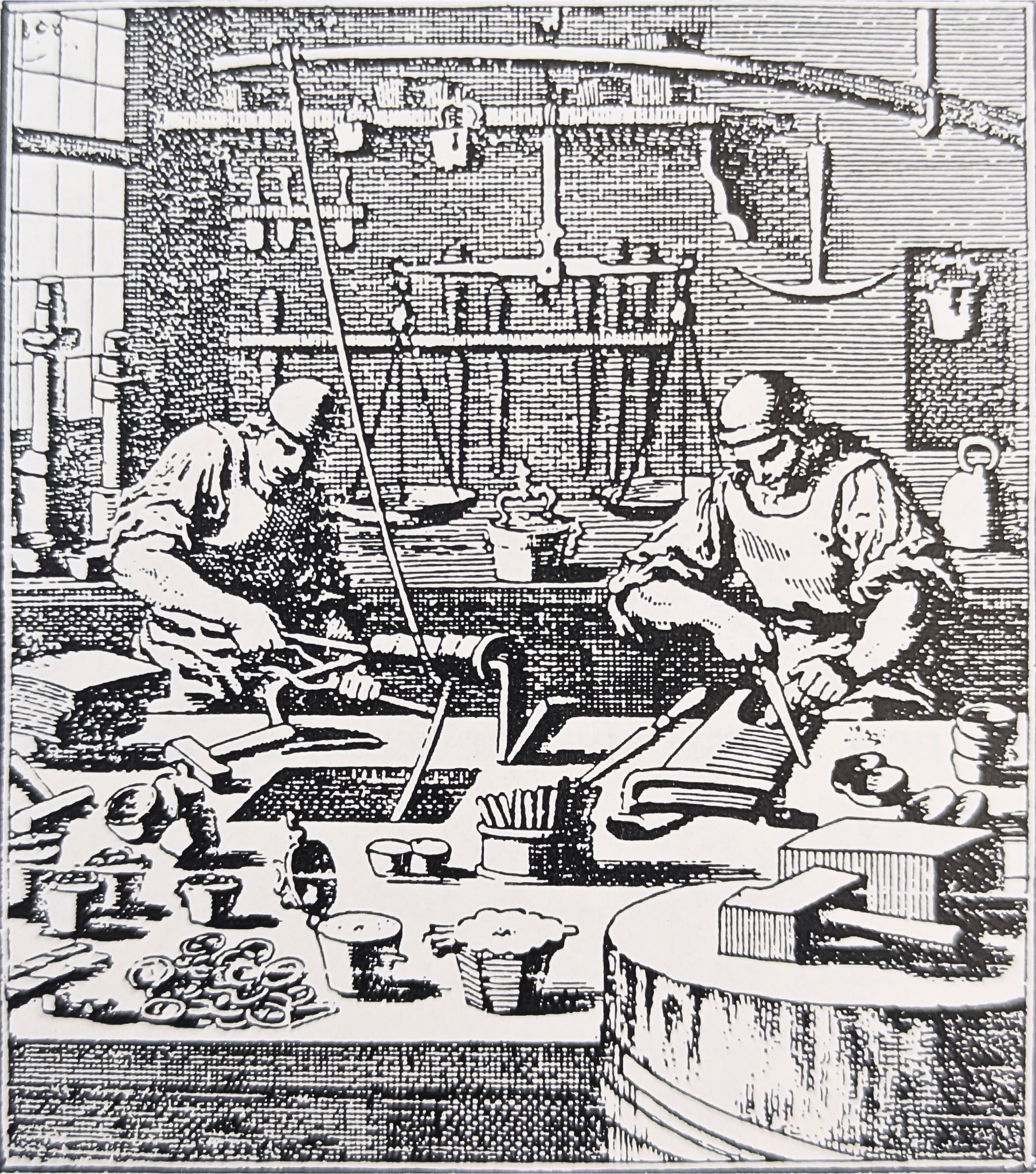
Weight Makers’ Workshop of 1698 showing pole-driven lathe activated by the foot
Arms and Royal Charter
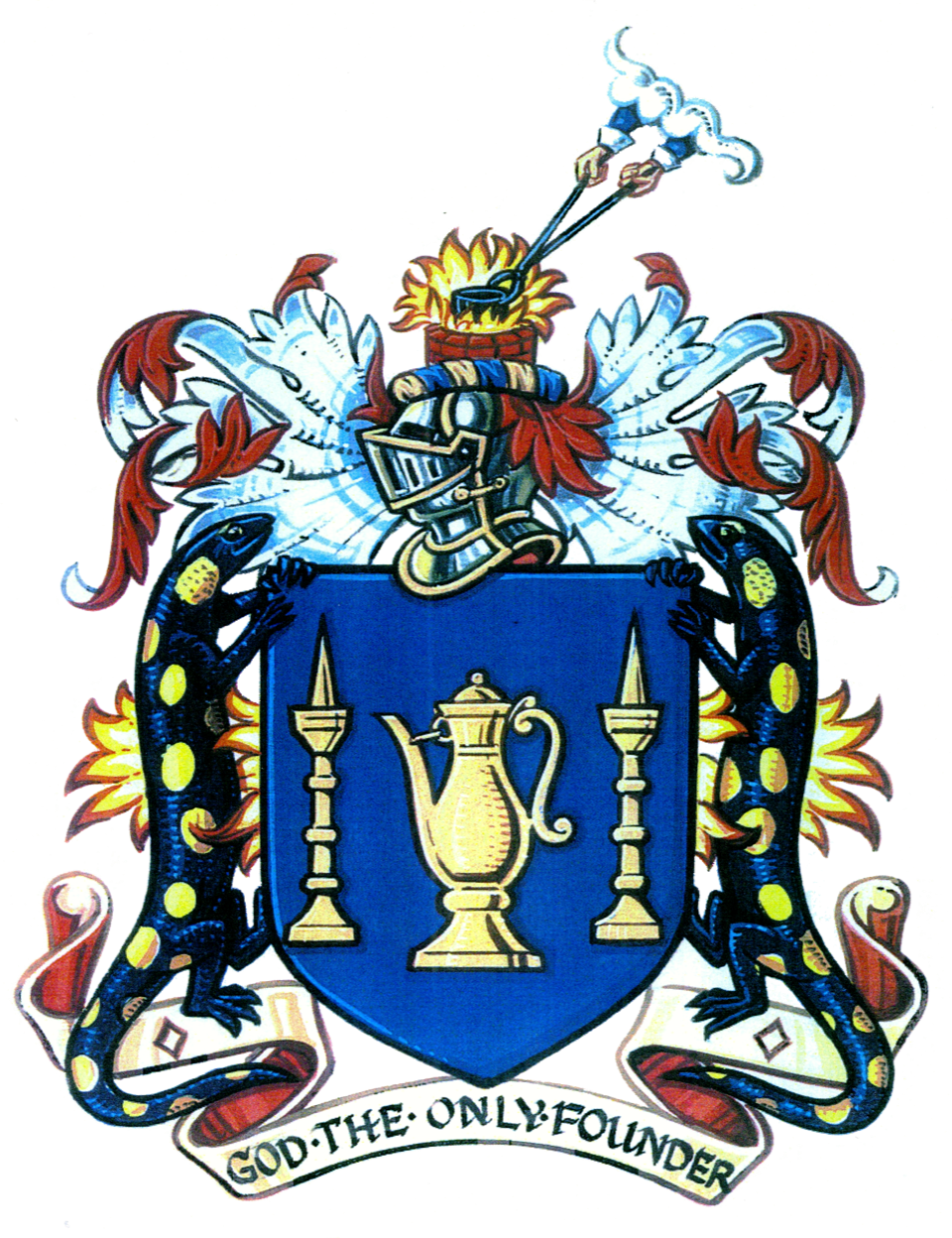
One of the Company's most important milestones came in 1590 when it received its Coat of Arms.
An even greater landmark followed in 1614 when King James I granted the Founders a Royal Charter. The Charter formally recognised the Company and empowered its officers to inspect workshops, warehouses and goods to identify faulty castings and deceitful weights.
Obtaining the Charter came at considerable expense and reflected the importance that the Company attached to securing its future. The Charter survived political upheaval during the seventeenth century and remains the foundation of the Company's governance today.
Many traditions emerged during this period. New members were expected to present the Company with a silver spoon on admission. Financial pressures later forced the sale of most of these spoons, although one belonging to Humphrey Bowen was preserved and remains a treasured part of the Company's heritage.
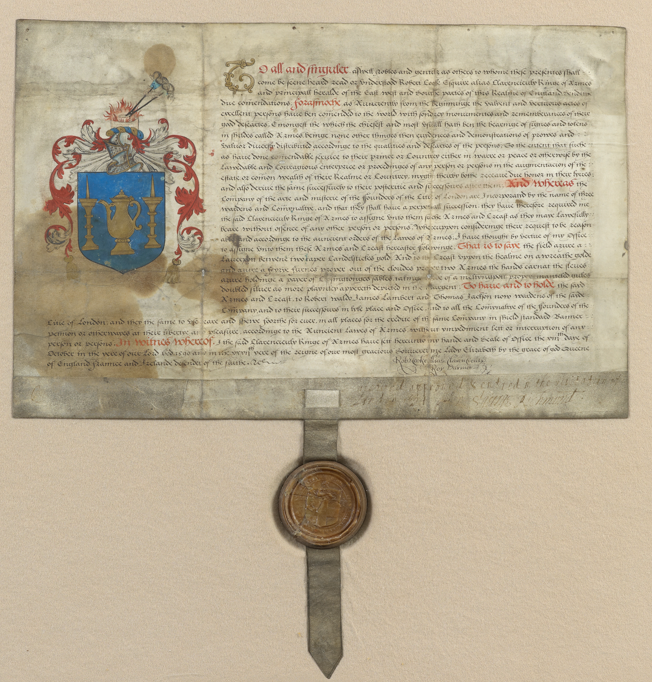
The Founders’ Grant of Arms, 1590, on display at Founders’ Hall
Founders' Hall Through the Centuries
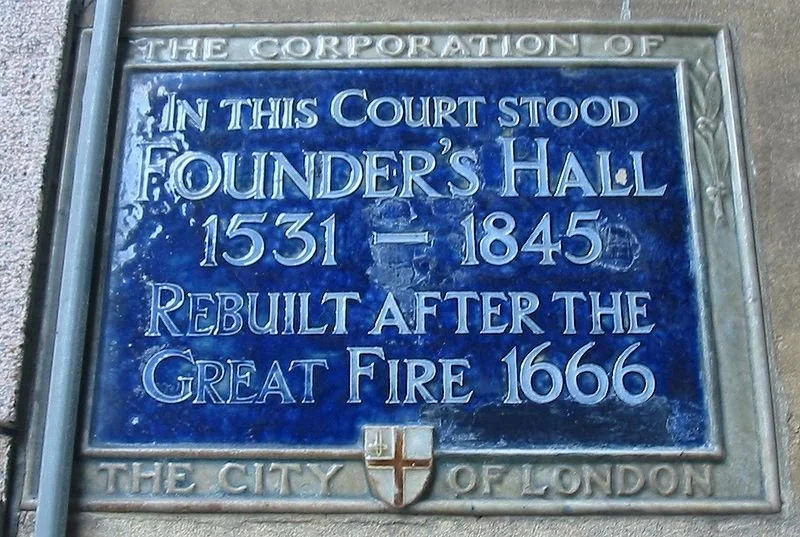
The Company's first Hall was built in Lothbury in the sixteenth century after the purchase of land in 1531. Completed in 1547, it served as the administrative and social centre of the Company for over a century.
The Hall was destroyed during the Great Fire of London in 1666 but rebuilt on the same site. Over the following centuries the Company occupied a succession of halls as London's commercial centre evolved.
The current Founders' Hall was opened at Cloth Fair in 1987. Situated beside the historic church of St Bartholomew the Great, it continues the Company's long tradition of providing a home for fellowship, governance and charitable activity.
From Trade Guild to Modern Company
As industrialisation transformed Britain, the Company's role evolved alongside the casting industry.
While maintaining strong links with foundries, engineers and manufacturers, the Founders increasingly focused on charitable giving, education and support for the wider community. The establishment of the Sexcentenary Charity Fund in 1965 and the Anniversaries Charity Fund in 1990 strengthened this work.
Today, Founders' Charities support educational, vocational and community initiatives, particularly those connected to engineering, manufacturing and technical skills. The acquisition of the Brunel Centre in Bedford in 2020 further expanded opportunities to support future generations entering engineering and related fields.
The Company also promotes excellence in the arts and industry through lectures, awards and competitions.
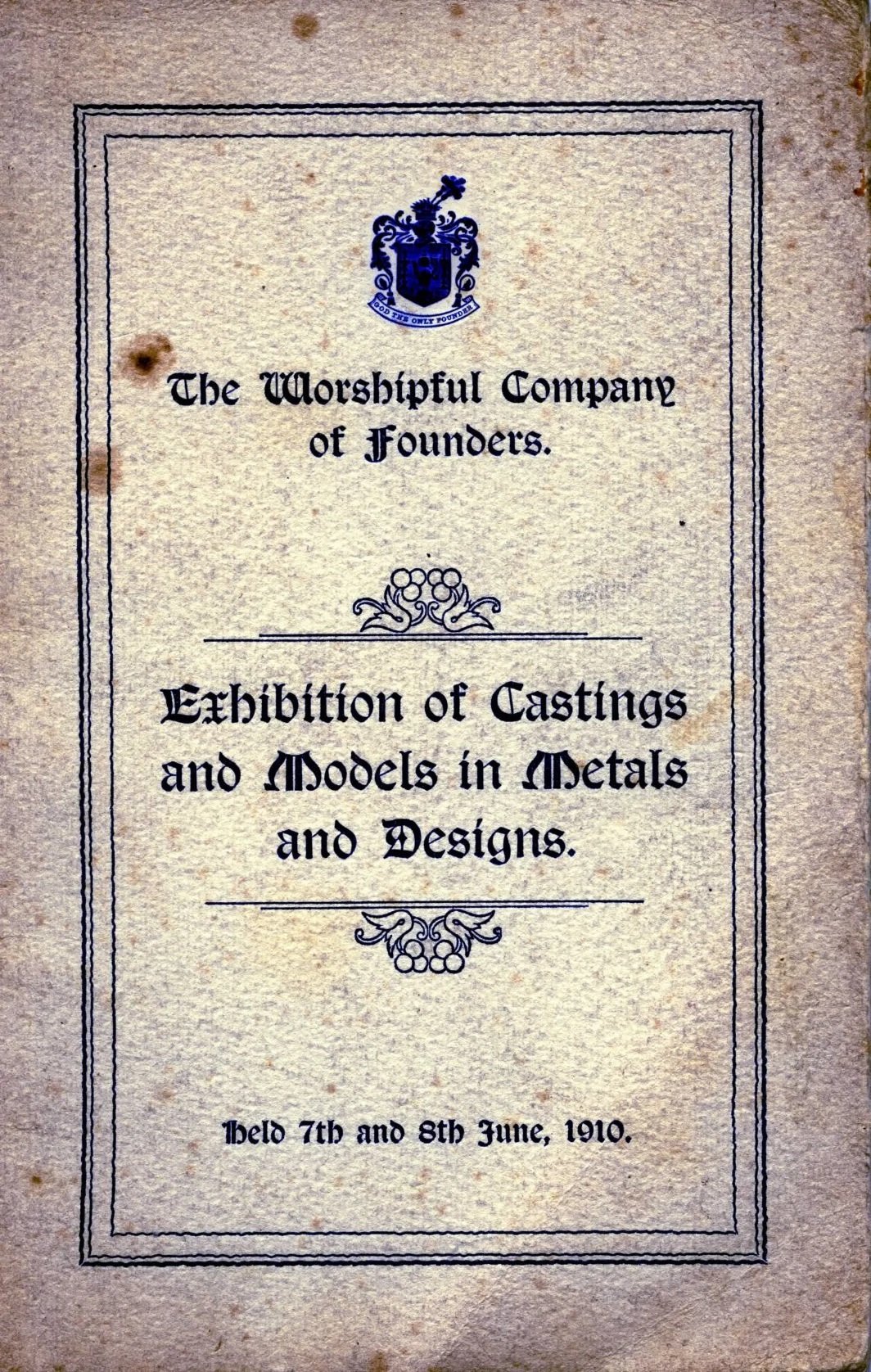
From the Founders’ Archive
The Founders Today
More than 660 years after its foundation, the Worshipful Company of Founders remains proud of its roots in the ancient craft of metal casting.
Although the Company no longer regulates the trade as it once did, it continues to champion the values that inspired its creation: excellence in craftsmanship, education, fellowship, charity and service.
From medieval workshops in Lothbury to Founders' Hall in Cloth Fair, the Company has adapted to changing times while maintaining a continuous connection to the craft and industry from which it grew.
-
Edward III
1365 John de Lincoln
Richard II
1366-90 Not known
1391 Thomas Grace
Robert Newman
Henry IV/V
1392-1423 Not known
Henry VI
1424 Walter Adam
Nicholas West
1425-7 Not known
1428 Walter Adam
William Byrd
1429-30 Not known
1431 William Turner
Simon Sterne
1432 John West
John Russell
1433-37 Not known
1438 John Russell
Robert Reynolds
Edward IV/V
Richard III
Henry VII
1439-96 Not known
1497 Robert Setcole
1498 Robert Setcole
1499 John Pinchbeck
1500 John Pinchbeck
1501 Robert Setcole
1502 Robert Setcole
1503 Randolf Austin
1504 Randolf Austin
1505 Randolf Austin
1506 Randolf Austin
1507 John Parker (or Sena)
1508 Robert Stacy
Henry VIII
1509 Robert Wells
1510 Robert Wells
1511 David Mills
1512 Thomas Halifax
1513 Thomas Halifax
1514 Thomas Halifax
1515 Robert Wells
1516 Robert Wells
1517 Robert Wells
1518 David Mills
1519 William Grigby
1520 William Grigby
1521 Thomas Sweeting
1522 Thomas Sweeting
1523 William Grigby
1524 William Grigby
1525 Thomas Sutton
1526 Thomas Sutton
1527 Robert Bridgewater
1528 Thomas Sutton
1529 William Knight
1530 William Knight
1531 Thomas Green
1532 Thomas Green
1533 John Wise
1534 John Wise
1535 Thomas Paxton
1536 Thomas Paxton
1537 Thomas Railton
1538 Thomas Railton
1539 Thomas Paxton
1540 John Wise
1541 James Sewen
1542 John Goter
1543 John Beer (or Bere)
1544 Humphrey White
1545 John Goter
1546 William Abbott
Edward VI
1547 William Abbott
1548 Humphrey White
1549 David Southern
1550 David Southern
1551 Roger Taylor
1552 Roger Taylor
Jane
1553 David Southern
Mary I
1554 Roger Taylor
1555 Christopher Stubbs
1556 Christopher Stubbs
1557 John Green
Elizabeth I
1558 John Jackson
1559 John Jackson
1560 Roger Taylor
1561 Christopher Stubbs
1562 Thomas Barley
1563 Robert Falconer (or Faulkner)
1564 Robert Falconer
1565 John Jackson
1566 Thomas Barley
1567 Robert Shurlock
1568 Robert Shurlock
1569 Uryan Daniell (formerly Evans)
1570 Robert Falconer
1571 John Chambers
1572 John Jackson
1573 Thomas Barley
1574 Robert Shurlock
1575 John Chambers
1576 John Chambers
1577 John Jackson
1578 Edward Falconer (or Faulkner)
1579 Edward Falconer
1580 Edward Hearne
1581 Edward Hearne
1582 John Jackson
1583 John Chambers
1584 Edward Falconer
1585 Edward Hearne
1586 Uryan Daniell
1587 Thomas Horton
1588 Robert Waldo
1589 Robert Waldo
1590 Nicholas Roberts
1591 Nicholas Roberts
1592 John Chambers
1593 Edward Falconer
1594 Edward Hearne
1595 Robert Waldo
1596 Thomas Jackson (Died in office)
1597 Nicholas Roberts
1598 Richard Rowdinge
1599 Richard Rowdinge
1600 Robert Waldo
1601 Nicholas Roberts
1602 Edward Hearne
James I
1603 Richard Rowdinge
1604 Humphrey Liddell
1605 Humphrey Liddell
1606 Richard Rowdinge
1607 Edward Gaseley
1608 Edward Gaseley
1609 Humphrey Liddell
1610 Richard Rowdinge
1611 Ezekiel Major
1612 Ezekiel Major
1613 John Hull
1614 Richard Rowdinge
1615 Ezekiel Major
1616 John Hull
1617 Edward Parnell
1618 John Rawlings
1619 John Hull
1620 Hugh Rogers
1621 Edward Pamell
1622 John Rawlings
1623 Ezekiel Major
1624 John Bowen
Charles I
1625 Francis Curwen
1626 Abraham Woodall
1627 John Hull
1628 Francis Curwen
1629 Abraham Woodall
1630 John Rawlings
1631 Richard Weoley (or Willey)
1632 Sisley Edwardes
1633 Francis Curwen
1634 Abraham Woodall
1635 William Randall
1636 Henry Carless (or Carles)
1637 John Wright
1638 Joseph Parratt
1639 Anthony Whaley
1640 Richard Weoley
1641 Sisley Edwardes
1642 Henry Carless
1643 Joseph Parratt
1644 Thomas Bosworth
1645 Richard Smith
1646 Thomas Stead
1647 Thomas Stead
1648 Richard Smith
Oliver Cromwell LP
1649 William Yardsley
1650 Joseph Parratt
1651 Henry Carless
1652 Simon Cage
1653 John Wright
1654 William Yardsley
1655 Stephen Pilchard
1656 Simon Cage
1657 William Burroughes
Richard Cromwell LP
1658 Stephen Pilchard
1659 William Burroughes
Charles II
1660 Marmaduke Almond
1661 William Ragdale
1662 William Yeames
1663 Marmaduke Almond
1664 William Ragdale
1665 Clement Dawes
1666 John Beauchamp
1667 Moses Brown
1668 George Dixon
1669 George Dixon
1670 John Stead
1671 Timothy Lane
1672 Moses Brown
1673 Andrew Grace
1674 Roger Fisher
1675 Clement Dawes (Died in office)
Andrew Grace
1676 Timothy Lee
1677 John White
1678 Abel Hodges
1679 Daniel Houghton
1680 Peter Causton
1681 Thomas Aylward
1682 John Armiger
1683 John Underwood
1684 Col Theophilus Oglethorpe
James II
1685 John White, Deputy Master
1686 William Rutter, ditto
1687 Richard Meakins, ditto
1688 William Crossfield
William III & Mary II
1689 George Chew
1690 Thomas Webb
1691 Henry Hemings
1692 Thomas Hawgood
1693 John Wingrave
John Attwick
1694 Thomas Watson
1695 Edmund Read
1696 Samuel Pilchard
1697 Matthew Beaver
1698 Noah Delaunay
1699 William Crossfield
1700 Thomas Aylward
1701 Noah Delaunay
Anne
1702 Noah Delaunay
1703 William Rogers
1704 Thomas Newman
1705 Richard Nevill
1706 Stephen Reynolds
1707 John Smith
1708 Noah Delaunay
1709 Joseph Dampney
1710 Samuel Newton
1711 John Brooks
1712 William Hayward
1713 John Meakins
George I
1714 Daniel Hancock
1715 Robert Burton
1716 John Wade
1717 Anthony Giles
1718 William Warren
1719 Robert Turner
1720 Arthur Gardner Snr
1721 John Peel
1722 John Scott
1723 William Parsons
1724 Philip Davies
1725 John Richardson
1726 David Higby
George II
1727 Daniel Hudson
1728 Robert North, (Dismissed)
Robert Burton
1729 John Halfhide
1730 Anthony Webster
1731 Capt. Richard Nevill
1732 Henry Hines
1733 Daniel Lawrence
1734 William Gardner
1735 John Sunderland
1736 Thomas Pearce
1737 Isaac Dobbins
1738 John Bridge
1739 George Meal
1740 John Giles
1741 Samuel Goadby
1742 William Ford
1743 John Beard
1744 John Bladwell
1745 Samuel Collisham
1746 John Walker
1747 John Bundy
1748 John Allen
1749 Nathaniel Clarke
1750 John Tillier
1751 William Gibbs
1752 John White
1753 Patrick Hawes
1754 Thurston Ford
1755 William Jones
1756 Richard Chapman
1757 John Marsh
1758 Thomas Tuck
1759 Richard Chapman
George III
1760 Walter West
1761 Thomas Clark
1762 John Newton
1763 Daniel Bucknell
1764 Edward Lloyd
1765 Ambrose Denman
1766 John Cuttridge
1767 William Lister
1768 William White
1769 Samuel Rogers
1770 William Hone
1771 Samuel Jacombe
1772 Tuffin Shepherd
1773 Edward Holmes
1774 Thomas Walker
1775 Sacheverell Hollyer
1776 William Lane
1777 John Cole
1778 John Jenkin
1779 Thomas Cartwright (Died in office)
Edward Watson
1780 William Kinsman
1781 Joseph Keys
1782 John Trent
1783 William Rogers
1784 John Warner
1785 William Farm
1786 Tomson Warner
1787 William Newman
1788 James Haygarth
1789 Samuel Taylor
1790 John Hooper
1791 John Reynolds
1792 John Cave
1793 John Chamberlain
1794 James White
1795 William Borradaile
1796 John Rea
1797 William Timmins
1798 Joseph Bramley
1799 William Savill
1800 John Seale
1801 James Burrows
1802 Archdale Wilkins
1803 Thomas Hornsby
1804 William Dunbar
1805 John Rea
1806 Joseph Thornhill
1807 Michael Barnett
1808 John Batger
1809 Joseph Meyer
1810 Alexander Lean
1811 John Warner
1812 William Timmins
1813 Robert Westley
1814 James Burrows
1815 James Burrows
1816 William Gillman
1817 Edward Winter
1818 John Gray
1819 Joseph Warner
George IV
1820 William King
1821 William Barnes
1822 William Gillman
1823 Robert Davies
1824 William Borradaile
1825 William Roper
1826 Robert Warner
1827 John Warner
1828 Thomas Mears
1829 John Stott
William IV
1830 James Burrows
1831 James Chooling
1832 William Devey
1833 John Moxon
1834 Jeremiah Barratt
1835 William Hurrell
1836 John Chapman
Victoria
1837 John Burnell
1838 William Franks
1839 Thomas Moxon Jr
1840 John Stahlschmidt
1841 William Christie
1842 Francis Bacon
1843 Charles Botten
1844 John Sexton
1845 William Huggins
1846 William Hems
1847 Charles Warner
1848 Stephen Lowdell
1849 Charles Mears
1850 James Moul
1851 Mark Marsden
1852 William Williams
1853 William Williams
1854 George Mears
1855 John Christie
1856 Thomas Oliver
1857 William Hems Jr
1858 William Franks
1859 William Burton
1860 Thomas Moxon Jr
1861 William Christie
1862 Richard Dale
1863 William Hems Jr
1864 Gervase Parnell
1865 Charles Warner
1866 Robert Warner
1867 James Franks
1868 Mark Marsden
1869 Edward Metcalf
1870 William Franks
1871 Francis Pritchett
1872 Edward Baldock
1873 Edward Franks
1874 Joseph Holland
1875 William Fowler
1876 George Forrest
1877 Henry Hodsoll Heath
1878 George Aitchison
1879 Micajah Walker
1880 John Stahlschmidt
1881 Gervase Parnell
1882 Robert Warner
1883 Francis Pritchett
1884 George Berry
1885 Capt. Edward Baldock
1886 William Fowler
1887 William Evan Franks
1888 George Cockerell
1889 George Forrest
1890 Walter Franks
1891 Samuel Linder
1892 William White
1893 Henry Hodsoll Heath
1894 Frederick Harris
1895 Edward Bridgewater
1896 Charles Devey
1897 William Chambers
1898 Octavius Jepson
1899 James Dixon
1900 Richard Williams
Edward VII
1901 William Bruty
1902 Robert Wales
1903 Frederick Todd
1904 Walter Franks
1905 Montague Herbert
1906 Henry Franks
1907 Charles Devey
1908 William Tetley
1909 Sydney Pollard
George V
1910 George Hilditc Walker
1911 Wynne Baxter
1912 Ernest Hepburn
1913 Richard Williams
1914 William Cooper
1915 Alfred Brookman
1916 Edmund Lucas
1917 William Aitchison
1918 Henry Young
1919 James Taylor
1920 Henry Tait Moore
1921 William Devey
1922 Charles Miller
1923 William Hibbert
1924 Percy Horley
1925 Capt. Alfred Hodsoll Heath
1926 Soanes Gardner
1927 Augustus Blaxter
1928 Lt Col Dudley Cookes DSO
1929 Harry Hughes
1930 Dr. Hugh Stannus
1931 Percy Young
1932 Stanley Young
1933 Robert Warner
1934 James Taylor
1935 Robert Hatswell
Edward VIII
1936 William Christopher
George VI
1937 Francis Miles
1938 Robert Ababrelton
1939 Gordon Young
1940 Douglas Young
1941 Percy Horley
1942 Capt. Alfred Heath
1943 Augustus Blaxter
1944 Lt Col Dudley Cookes DSO
1945 Charles Woodfield
1946 Stephen Warner
1947 William Fossick
1948 Leslie Corbould- Ellis
1949 Augustus Blaxter
1950 Jack Wheeler
1951 George Cotton
Elizabeth II
1952 Kenneth Adams
1953 Dr. Hugh Stannus
1954 Frank Greene
1955 Herbert Bradbrook
1956 Leonard Cotterell
1957 Rev Richard Walker
1958 George Ilsley
1959 Arthur Jennings
1960 Douglas Young
1961 Ernest Moss
1962 Samuel Walker
1963 Charles Littler Smith
1964 Lt Col James Thomson
1965 Guy Hadley
1966 Harvey Young
1967 Dr. James Pearce
1968 Reginald Longcroft
1969 Paul Gunn
1970 Patrick, Lord Rathcreedan
1971 Capt. William Gregson
1972 John Beardmore
1973 Peter Blaxter
1974 John Cully
1975 Francis Rowe
1976 Raymond Scott
1977 James Longcroft
1978 Lewis Wilson
1979 Christopher Savory
1980 Charles Wilson
1981 Sydney Farmer
1982 J Alan Prior
1983 William Warner
1984 John Hinman
1985 Noel Crighton
1986 Peter Swan
1987 Arthur Mitchener
1988 John Williams
1989 Harry Draycott
1990 John Cordle
1991 Brian Farmer
1992 George Lunt
1993 David Lindop
1994 David Atterton
1995 Robert Stevens
1996 Robert Lightfoot
1997 William Fossick
1998 Robert Savory
1999 Leslie Kemp
2000 Sir Ian Ley Bt
2001 Anthony Newman
2002 Nigel Turnbull
2003 Jeremy Lansdell
2004 Richard Martin
2005 Philip Prain
2006 Christopher Rogers
2007 John Kelly
2008 Ronald Sichel
2009 Thomas Rollason
2010 Clive Allport
2011 David Cogan
2012 Philip Horton
2013 Andrew Gillett
2014 Patrick Draycott
2015 John Butterworth
2016 William Beadles
2017 Michael Swan
2018 Matthew Farrant
2019 Martin Shenton
2020 David Robinson
2021 John Wood
Charles III
2022 Robin Holmes
2023 Nicholas Butterworth
2024 Alan Hughes
2025 HHJ Simon Oliver