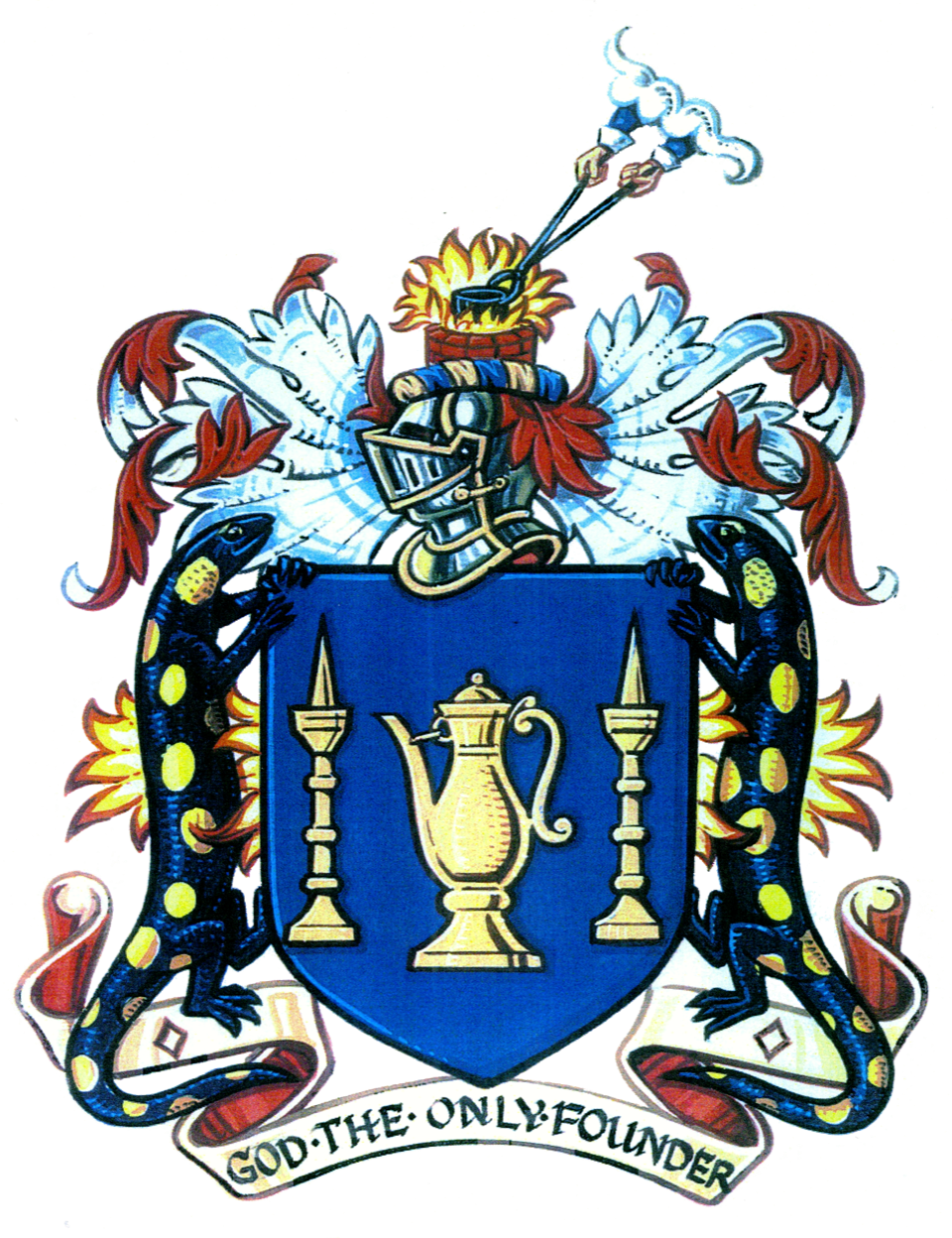
This article is written by Alan Hughes, Immediate Past Master, and is taken from a recent talk delivered to the Antiquarian Horological Society.
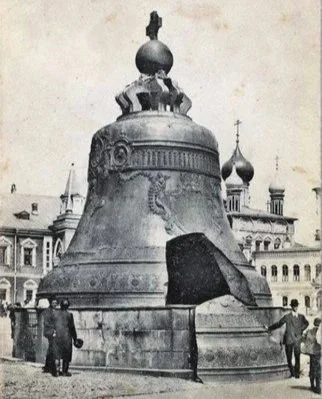
The Great Bell of Moscow
Arguably, the three best-known bells in the world are the Great Bell of Moscow, Big Ben, and the Liberty Bell.
The Great Bell of Moscow is the largest bell ever cast on planet Earth. It is a little under 22 feet in diameter, weighs in excess of 200 tons, and was cast, at the second attempt, in 1735. It has never been hung or rung. You will notice that it has a piece missing — a piece which weighs around 11 tons.
Big Ben, at the time the largest bell in the United Kingdom, is 9 feet in diameter and weighs a little over 13½ tons. It was cast on Saturday 10 April 1858 at our Whitechapel Road foundry. To this day it remains the largest bell we have ever cast. The bell that we hear today is the second Big Ben. The first, cast by another company, cracked during testing. Our price for recasting it, invoiced on 28 May 1858, was £572 2s.
And finally, the Liberty Bell — with the bell we see today being the third Liberty Bell.
The one thing they all have in common is that they are all, variously, cracked or broken. Not, I submit, a ringing endorsement of the centuries-old craft of bell founding.
Given that our American cousins will be celebrating the 250th anniversary of their independence from Great Britain on 4 July this year, I shall begin with the Liberty Bell.
The Origins of the Liberty Bell
The Liberty Bell was not how it started out. The original bell, cast at our Whitechapel Road foundry by Thomas Lester in 1752 — some 24 years before independence — was commissioned to commemorate the 50th anniversary of the founding of the State of Pennsylvania.
Lester’s commission was to produce a bell weighing approximately 2,000 pounds — one American ton — or, in English terms, a little under 18 hundredweight, and in European terms just over 907 kilograms. Such a bell would have been approximately 3 feet 11 inches in diameter and, although not tuned, would have sounded approximately the note E. Coincidentally, that is one octave higher than Big Ben, which also sounds approximately the note E.
Importantly — and this cannot be overstated — was the inscription cast in relief around the shoulder of the bell:
“Proclaim Liberty Throughout All The Land Unto All The Inhabitants Thereof.”
(Leviticus, Chapter 25, Verse 10)
The full verse reads:
“And ye shall hallow the fiftieth year, and proclaim liberty throughout the land unto all the inhabitants thereof: it shall be a jubilee unto you; and ye shall return every man into his possession, and ye shall return every man unto his family.”
At this point, history becomes somewhat confused.
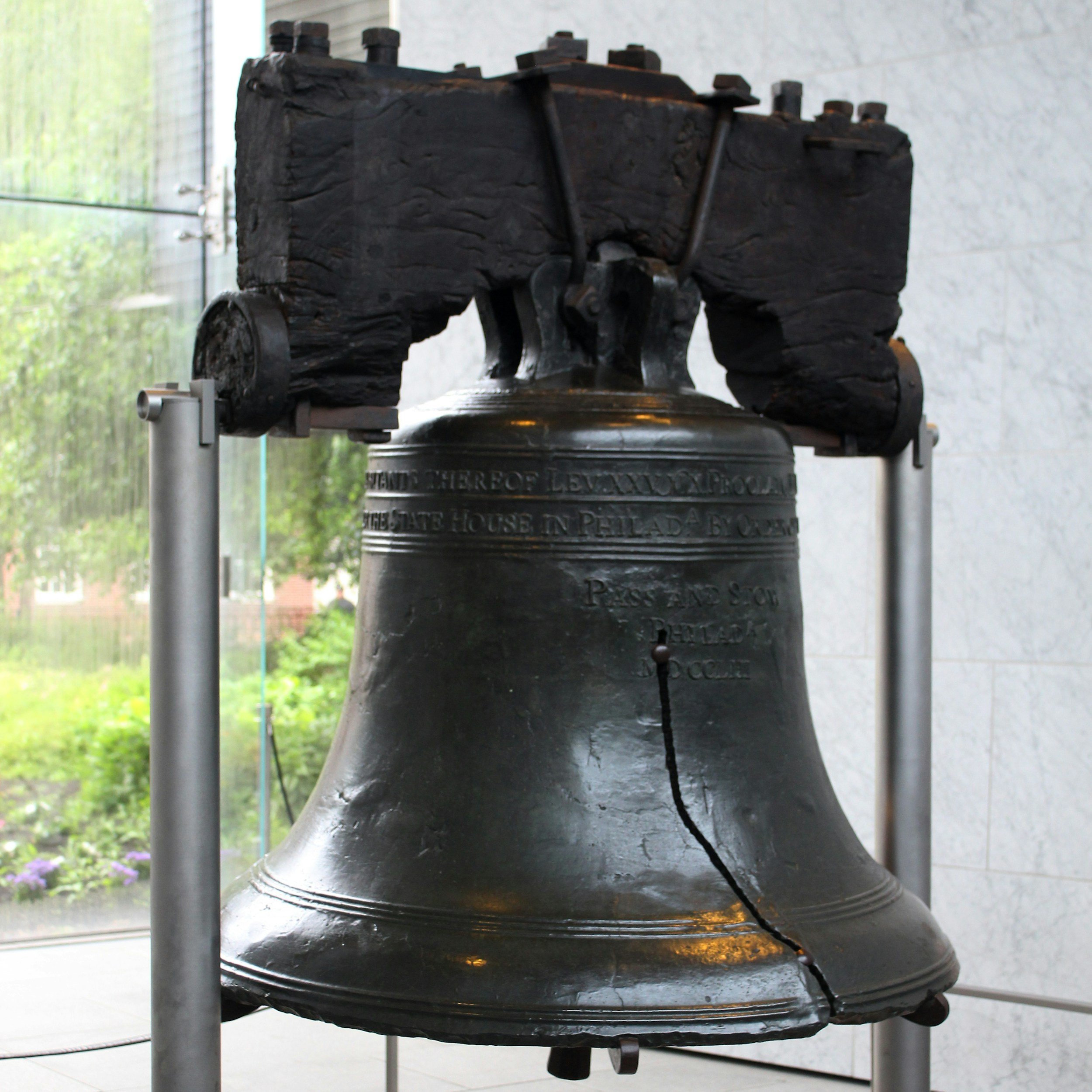
The ship delivering the bell took 11 weeks to arrive due to storms in the Atlantic — four weeks longer than normal. One account states that the storms caused the cargo to break loose in the hold, cracking the bell in transit. Another states that the bell met all expectations upon arrival, but cracked as soon as it was struck.
Whatever the truth, the bell was recast to the same size and with the same inscription by two local founders, John Pass and John Stow.
Thomas Lester did provide a quotation for recasting the bell, but this was not accepted due, in part, to time constraints and the practical difficulty of returning the bell to England.
Pass and Stow diagnosed the problem as brittleness caused by excessive tin content.
Bell Metal
At this point, it is worth saying something about bell metal. Bell metal is a mix of copper and tin, with a tin content between 20% and 24% — a high tin bronze. The material is, I submit, largely useless for making anything other than bells.
Although copper and tin are both soft metals in themselves, when combined they form a hard material — and the higher the tin content, the harder and more brittle it becomes. And if something is to ring and resonate, then a hard material is essential. Soft metals go thud — and bells that go thud do not sell very well.
Pass and Stow, being iron founders with limited experience of bronze or bells, took a logical approach. They reduced the tin content when recasting the bell, adding more copper. They faithfully copied the size, shape and inscription, substituting their own names for Lester’s.
Their first attempt — the second Liberty Bell — looked satisfactory but, according to a contemporary account, sounded “like two coal scuttles being banged together.” It was therefore broken up and recast once again, this time restoring the original tin content. That is the bell we see today. It retains the same size, shape and inscription, but bears the names of Pass and Stow.
Even then, it was not known as the Liberty Bell.
According to one account, it acquired the name because it was rung at the time of the Declaration of Independence in 1776. According to another, there is no evidence of this, and the name only came into use in the early 19th century. By the mid-19th century, however, it had become firmly established as the Liberty Bell.
Later Commemorations
Whitechapel’s connection to the Liberty Bell did not end there. In the second half of the 20th century, a number of replicas of Lester’s original bell were cast.
In 1976, to mark the 200th anniversary of American independence, Whitechapel was commissioned to cast the Bicentennial Bell. Cast in the same pit as the original 1752 bell, it is some six times heavier, measuring 6 feet 10 inches in diameter and weighing around 5½ tons. It remains the heaviest casting made at the foundry in the 20th century.
It was cast on Thursday 4 March 1976 at approximately 4pm and rung officially for the first time by Queen Elizabeth II on 4 July that year.
Its inscription reads:
“For the People of the United States of America
From the People of Britain
4 July 1976
Let Freedom Ring”
For me, however, the story ends on a rather sad note. Although originally equipped to be rung — with both a motor and external hammers for tolling — the bell was eventually dismantled. By 2013 it had been placed into storage, and although it now hangs again in Philadelphia, it cannot be rung.
So much for “Let Freedom Ring.”
There are parallels in this country. The 23-ton bell cast for the London Olympic Games in 2012 — the largest tuned bell in the world at the time — also remains in place but cannot be rung, reportedly for fear of disturbing the neighbours.
A Light Interlude
In the days leading up to 4 July 1976, we encountered a rather noisy demonstration outside the foundry. A group from the Procrastinators Society of America, suitably escorted by police, were protesting that we had failed to honour our 1752 warranty on the original Liberty Bell.
Placards reading “What about the warranty?” and “We got a lemon” were much in evidence.
We invited them in for sherry and discussion, and after prolonged negotiation offered to recast the bell free of charge — provided it could be returned in its original packing, accompanied by the original invoice.
They promised to give the matter serious consideration. As procrastinators, they warned that this might take some time.
Here we are, 50 years later. A decision is still awaited.
The Bells of St Michael’s, Charleston
There have been many other struggles for liberty. In the United States, the Civil War, fought between 1861 and 1865, left deep divisions that are still reflected in how it is remembered.
This brings me to the bells of St Michael’s Church in Charleston.
In 1764, Thomas Lester cast a ring of eight bells for the church — just the third such peal sent to the American colonies.
During the War of Independence, the bells were seized by British troops and returned to Whitechapel. After the war, they were redeemed by a merchant and sent back to Charleston.
During the Civil War, the bells were removed for safekeeping in Columbia. In 1865, the city was largely destroyed by fire, and the building housing the bells was burnt. The bells were damaged — cracked, broken and partially melted.
The metal was recovered and sent once more to Whitechapel, where, in 1866, a new ring was cast.
The bells were hung, but only in a manner allowing them to be chimed rather than rung full circle.
In 1989, following Hurricane Hugo, a major restoration was undertaken. The bells were dismantled and once again returned to Whitechapel, where new fittings and framework were added before they were sent back to Charleston and reinstalled for full-circle ringing.
In total, these bells have crossed the Atlantic seven times — possibly a record.
Bells and Resilience
The affection of the people of Charleston for their bells is evident throughout this history. Despite war, fire and destruction, the bells were protected, restored and repeatedly returned.
Bells clearly matter.
They also mark more recent events. Following the attacks of 11 September 2001, a bell was cast at Whitechapel in 2002 and presented by the City of London to the City of New York as a symbol of hope and enduring connection.
It now hangs at St Paul’s Chapel near the World Trade Center site, bearing the inscription:
“Forged in Adversity — 11 September 2001”
Conclusion
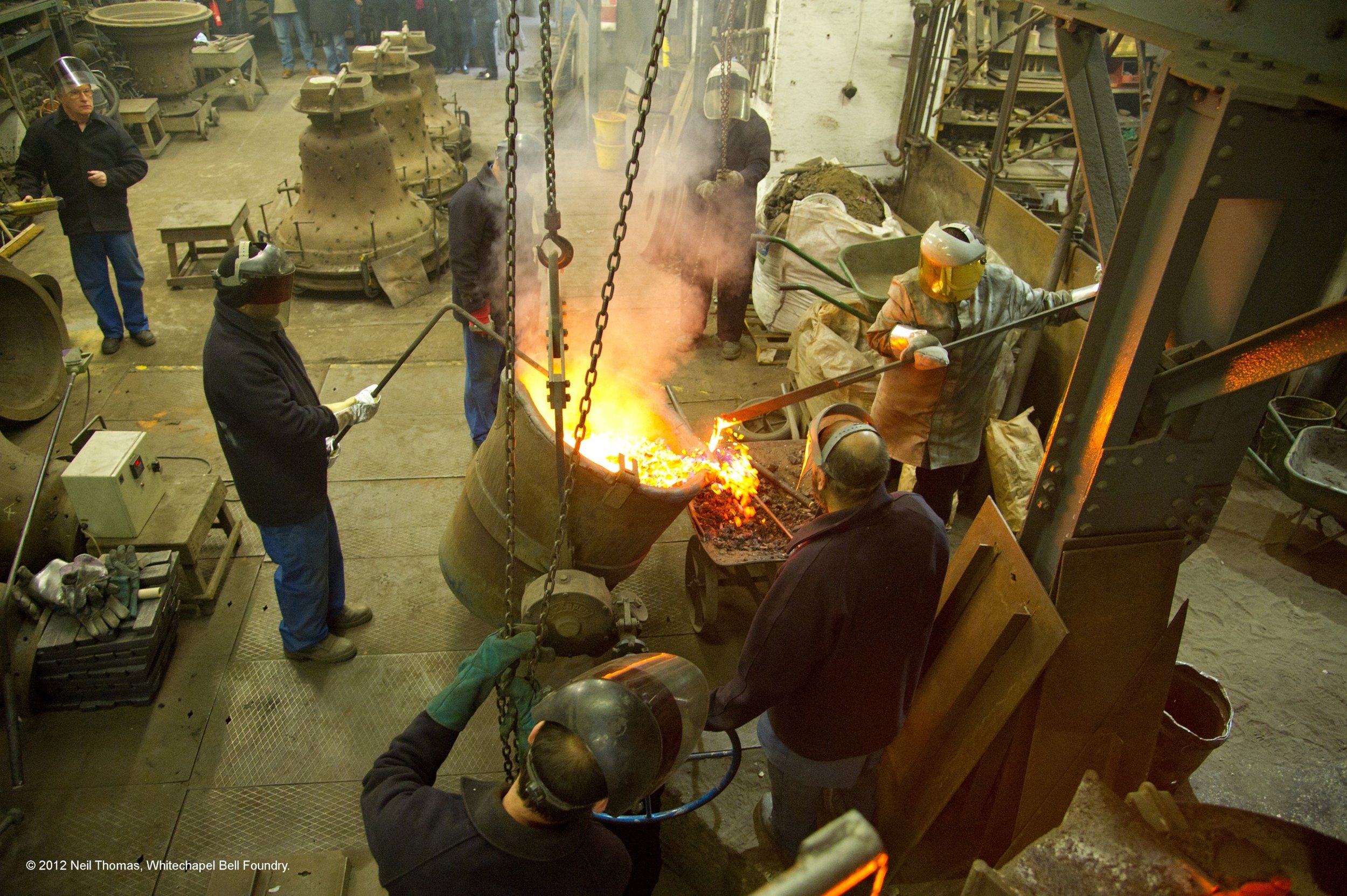
Credit: Neil Thomas, The Whitechapel Bell Foundry
These examples represent only a small fraction of the many thousands of bells — from tower bells to handbells — that have travelled from Whitechapel to America over nearly 300 years.
They now ring in churches, schools and cathedrals across the United States, all originating from the same small foundry in Whitechapel Road — the same foundry that cast, in 1752, the bell that would become known as the Liberty Bell.
As horologists will appreciate, time moves only forward, at the constant rate of 60 minutes per hour.
And here, my time is up.