Warwick Manufacturing Group, University of Warwick – connecting industry and academia
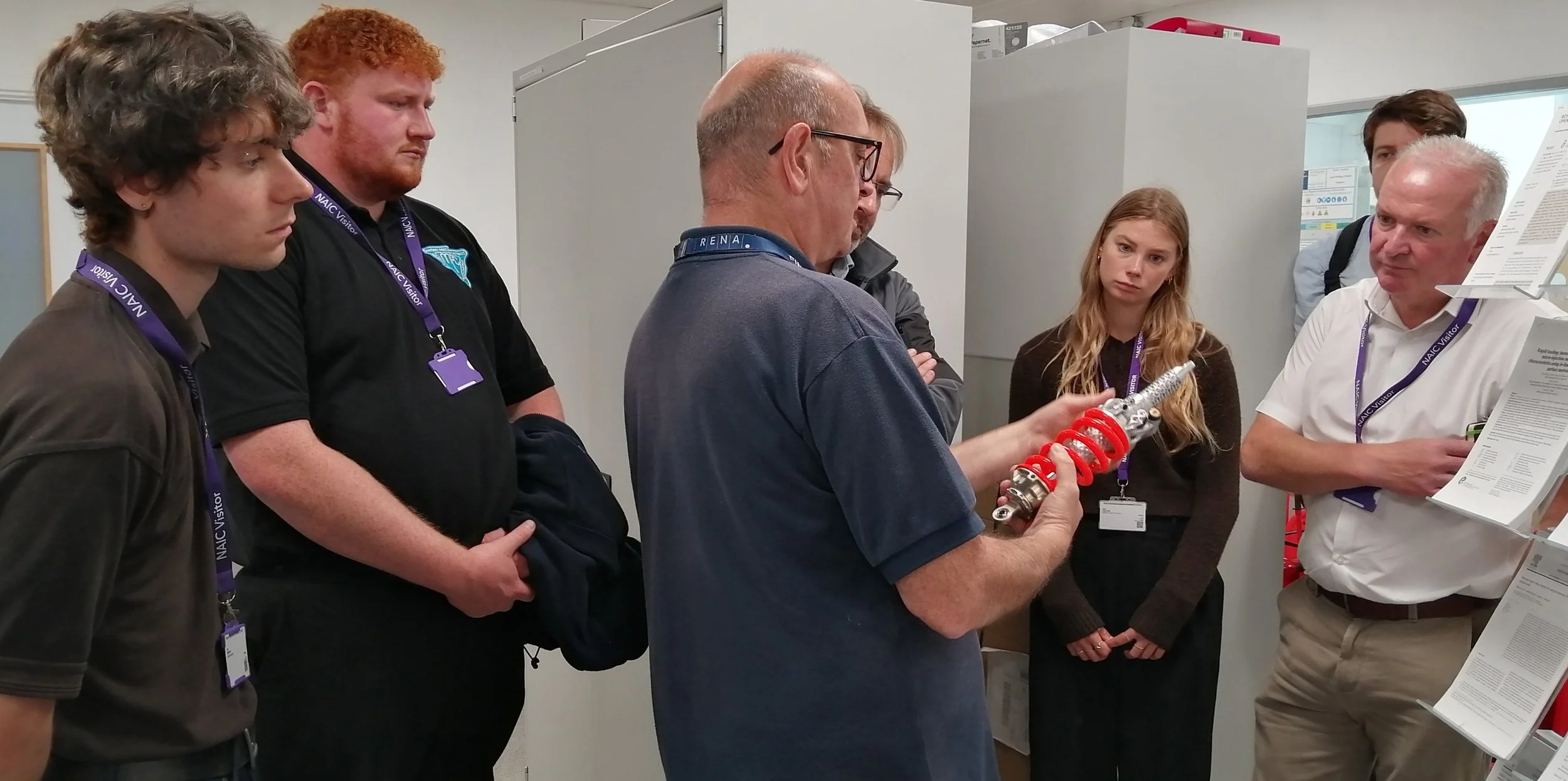
Members and guests of The Worshipful Company of Founders’ Industry Committee recently enjoyed a visit to the Warwick Manufacturing Group, WMG, at the University of Warwick.
The WMG was founded by the late Professor Lord Kumar Bhattacharyya in 1980, with a singular mission: to reinvigorate UK manufacturing through research and knowledge transfer. The WMG is now a ‘multi-disciplinary department renowned for tackling industrial, environmental and societal challenges through collaborative research with companies of all scales and complexities.’ Their ‘industrially-informed undergraduate and postgraduate education programmes create pipelines of talented graduates equipped with the skills needed to thrive in current and future industries.’
Our visit was hosted by Dr Russ Hall, Lead for Sustainable Manufacturing and Circular Economy, who focusses on industrial decarbonisation & sustainability, and Dr Felix Martin, WMG Project Engineer. Both Felix and Russ have been involved in projects for the foundry and castings industry over recent years, working closely with the Cast Metals Federation on decarbonisation projects and Felix has previously presented results of his energy and sustainability work with Welshpool based automotive component supplier, CastAlum, at industry technical events such as CASTcon.
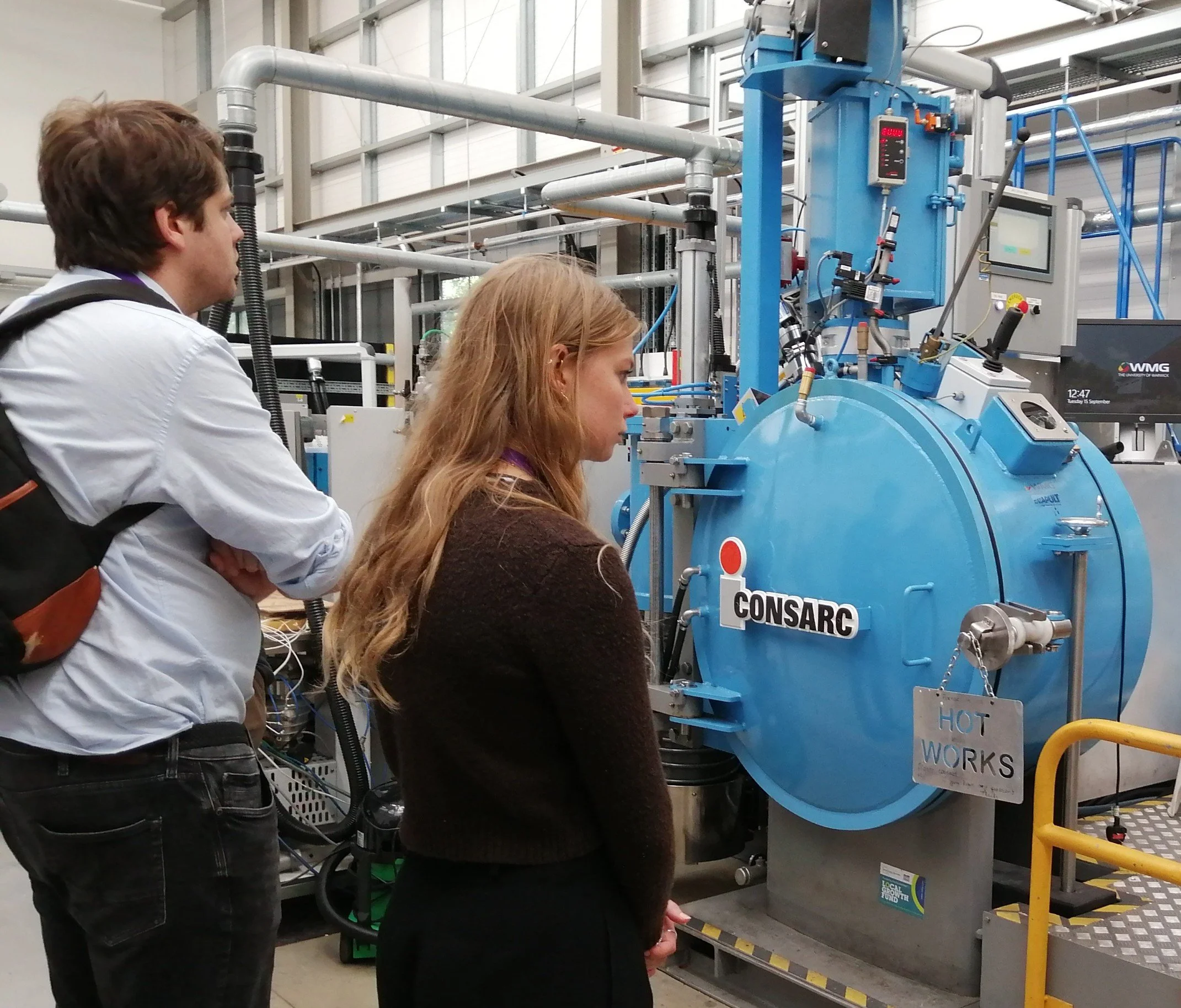
Our group heard about the important work that the WMG team do connecting industry, academia and government and helping to ensure that the voice of SMEs (small and medium sized enterprises) in UK supply chains are heard.
Their core themes include:
· Manufacturing & systems: focusing on additive manufacturing (3D printing complex, high-value components), digital lifecycles, virtual simulations, and building resilient, sustainable digital supply chains, manufacturing productivity and resilience,
· Electrification - efficiency and affordability,
· Transport: electrification and decarbonization. This includes next-generation battery materials and cell manufacturing, power electronics, electric machines, and drives.
· Materials: structural lightweighting, sustainable materials, recycling, polymer/nanocomposites, and advanced steel processing.
· Data - autonomous systems & computing: safe autonomy (automated driving systems), connected and cooperative autonomous vehicles using AI and 5G/6G, cyber security, and data science.
· Specialised technologies & health: applying high-value manufacturing knowledge to healthcare and medical technologies, human-technology interactions, and 3D imaging metrology.
Before a tour of facilities, including the steel research centre and the additive manufacturing labs, we heard about their work on industrial decarbonisation and sustainable manufacturing. This is particularly important for some non-ferrous UK foundries as they look to move away from dependence on the use of gas for metal melting whilst at the same time the cost of electricity is much higher. Electrification presents a real challenge to future competitiveness, therefore. At the same time foundries are looking to be environmentally sustainable and decarbonise their operations, whilst continuing to supply vital components for UK supply chains.
Several of the attendees were from SMEs in UK manufacturing and aluminium casting foundries so enjoyed the opportunity to be part of discussions about this important work over lunch.
As Industry Committee Chair, Pam Murrell, said, “Visits like this demonstrate the convening power of organisations like the Founders’ and helps to keep our members informed about the work being carried out in our research facilities to address some of the challenges facing the industry.
“I was particularly pleased that we were able to invite along some our undergraduate bursary recipients, with the Founders’ charities supporting the travel costs for these students. The opportunity to get out and about, to meet industrialists and researchers and fellow Founders’ is important for the professional development of these young people.”
Members: Look out on the website and in the newsletter for forthcoming visits coming up in 2027.